
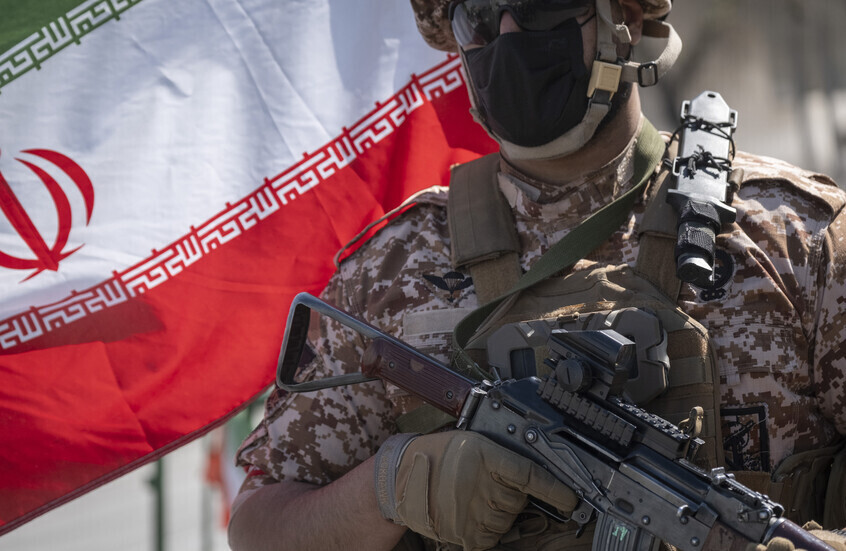
“They Will Regret It”.. Commander of Iran’s Ground Forces Vows Decisive Response to Any Attack
Middle East News Network: The commander of the Iranian Army’s Ground Forces, Brigadier General Ali Jahan Shahi Ban, affirmed that Tehran’s response to any attack would be decisive, making the enemy regret its actions.
He described the readiness of ground force units to defend the country’s borders as “excellent,” according to Iran’s Fars News Agency.
He added that, given this fighting spirit and the inspiring, epic public support from all segments of the Iranian people for the armed forces, any attack by the enemy on the country’s land borders would be met with a decisive response that would make them regret it.
The Ground Forces commander reassured the Iranian people, saying: “The country’s borders enjoy security and stability thanks to the deployment of armed forces, where enemy movements are monitored and analyzed moment by moment.”
He stressed that, thanks to the vigilance of the “defenders of the people” stationed at the borders, any threat targeting the Iranian people would be firmly confronted.
Earlier, U.S. officials told Axios that President Donald Trump had given Iran a deadline of 3 to 5 days to unify its position behind a coherent proposal.
A U.S. source said Trump is willing to grant additional days of truce to allow the Iranians to organize their affairs, but emphasized that the extension would not be open-ended.
According to the same source, Trump’s negotiators believe that an agreement to end the war and address the remaining aspects of the nuclear program is still possible, but they fear that there is no one in Tehran authorized to say “yes.”
Officials explained that divisions within Iran have reached a state of “absolute division” between negotiators and the military, with neither side able to reach Supreme Leader Mojtaba Khamenei, who is reportedly largely unresponsive.
Sources revealed that these divisions began to emerge after the first round of talks in Islamabad, when the commander of the Revolutionary Guard and his deputies rejected much of what Iranian negotiators had discussed. The split deepened last Friday when Foreign Minister Abbas Araghchi announced the reopening of the Strait of Hormuz, only for the Revolutionary Guard to refuse implementation and begin publicly criticizing him.
Iran has not provided a substantive response to the latest U.S. proposal and declined to commit to a second round of talks in Pakistan, prompting the White House to effectively freeze diplomacy and cancel Vice President J.D. Vance’s planned trip.
Meanwhile, Iran’s Permanent Representative to the United Nations, Amir Saeid Iravani, hinted at the possibility of resuming a new round of negotiations with the United States in Islamabad, but under certain conditions.
In statements carried by Iranian television (SNN), Iravani said: “The U.S. naval blockade constitutes a violation of the ceasefire, and we have made it clear to the American side that this blockade must be lifted.” He added: “If the blockade is lifted, I believe the next round of talks will be held in Islamabad.”
These remarks come amid a stalemate in the negotiation track between Tehran and Washington, after the first round of direct talks held in the Pakistani capital failed to reach an agreement on a long-term settlement of the conflict.
Tensions between the two countries have escalated in recent weeks, against the backdrop of U.S. naval operations in the Gulf and the Indian Ocean, which Iranian officials described as hostile measures that contradict the spirit of the declared ceasefire between the two sides.
Source: RT + media outlets