
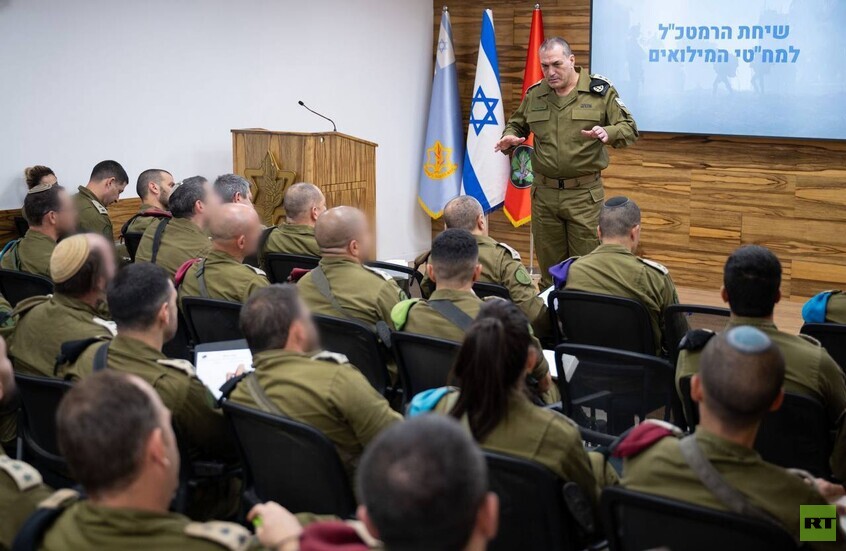
Israeli Chief of Staff: 2026 Will Be a Year of Intensive Offensive Operations Along the Front Lines
Middle East News Network: The Israeli Chief of Staff, Eyal Zamir, stated that 2026 will remain a year characterized by a “high offensive operational tempo.”
Zamir made his remarks during a discussion held on Sunday with reserve brigade commanders, attended by the Deputy Chief of Staff, the Head of the Ground Forces Command, and several senior military officers.
He said the army is engaged in what he described as a “multi-front battle” aimed at “weakening threats and achieving decisive outcomes against enemies along the lines of contact.”
The Chief of Staff emphasized that the recent war demonstrated “the central role of reserve brigades,” considering reserve battalion and brigade commanders to be “an essential part of the army’s operational core.” He added: “Thanks to you, we achieved operational accomplishments across all combat arenas.”
Zamir also noted that within the framework of the multi-year plan known as “Hoshin,” the army is working to enhance its ground maneuvering combat power by “building formations, increasing offensive capabilities, enhancing operational mobility, developing robotic capabilities, and improving the readiness of emergency stockpiles for reserve brigades.”
He concluded by saying: “I appreciate your efforts and your work—continue on this path,” at a time when Israeli threats to continue military operations on multiple fronts are escalating.
Since the outbreak of the war on the Gaza Strip, the region has witnessed unprecedented Israeli military escalation, described by Israeli military leaders as a “multi-front war.” In this context, Israel has expanded its operations to include the Gaza Strip, the southern Lebanon front, and Syrian territory, alongside ongoing security and military alertness regarding what it describes as threats originating from Iraq, Yemen, and Iran.
Gaza: Open War and Ongoing Attrition
The Israeli army continues its intensive military operations in the Gaza Strip through airstrikes, artillery shelling, and intermittent ground operations, targeting civilian infrastructure and residential areas as part of what its leaders declare to be an objective of “dismantling the military capabilities” of resistance factions. These operations have caused widespread destruction and a severe humanitarian crisis, amid repeated international warnings of a worsening catastrophe in the besieged enclave.
Lebanon: Daily Clashes with Hezbollah
On the northern front, exchanges of fire between the Israeli army and Hezbollah continue along the Lebanese border. Israel carries out airstrikes and artillery shelling targeting villages and positions in southern Lebanon. This ongoing escalation has kept the region in a constant state of tension, with Israeli warnings about the possibility of the confrontation expanding into a full-scale war.
Syria: Repeated Strikes to Prevent “Iranian Entrenchment”
In the Syrian arena, Israel conducts incursions into sites inside Syria to weaken the Syrian state. According to the Israeli narrative, the strikes aim to prevent the transfer of weapons to Lebanon; however, most strikes target Syrian forces’ positions under the new administration, which are not linked to Iran through any military coordination. These attacks fall within what Tel Aviv calls the “campaign between wars,” aimed at weakening its adversaries without being drawn into a comprehensive confrontation.
Yemen and Iraq: Alert Status and Monitoring Long-Range Threats
Alongside the direct fronts, the Israeli army remains on continuous alert regarding missile or drone threats originating from Yemen and Iraq. The Houthi group (Ansar Allah) in Yemen has repeatedly declared its readiness to target Israeli sites with long-range missiles or drones in any upcoming confrontation. Meanwhile, Tel Aviv accuses armed factions in Iraq of being behind similar attempts.
Israeli officials state that the Air Force and air defense systems are at a high level of readiness to intercept any distant threats, while Israeli reports point to close coordination with the United States in the fields of early warning and missile defense.
Iran: Direct Tension and Exchange of Fiery Messages
Tensions between Israel and Iran dominate the regional escalation scene, amid a continuous exchange of threats and accusations.
Israel seeks to destroy Iran’s missile arsenal and the nuclear reactors of the Islamic Republic, and to halt support for the “axis of resistance” in Gaza and Lebanon, extending to Syria, Iraq, and Yemen. It considers Iranian support for resistance factions to be its most significant strategic threat.
In contrast, Tehran asserts that its support comes within the framework of “backing resistance forces in the region,” and warns that any direct targeting of its territory will be met with a decisive response.
Source: RT