
Trump: We Will Retrieve “Nuclear Dust” One Way or Another from Iran, and Tehran Will Not Obtain a Nuclear Weapon
Middle East News Network: U.S. President Donald Trump stated that the United States “will retrieve the nuclear dust one way or another,” that Iran will not be allowed to possess a nuclear weapon.
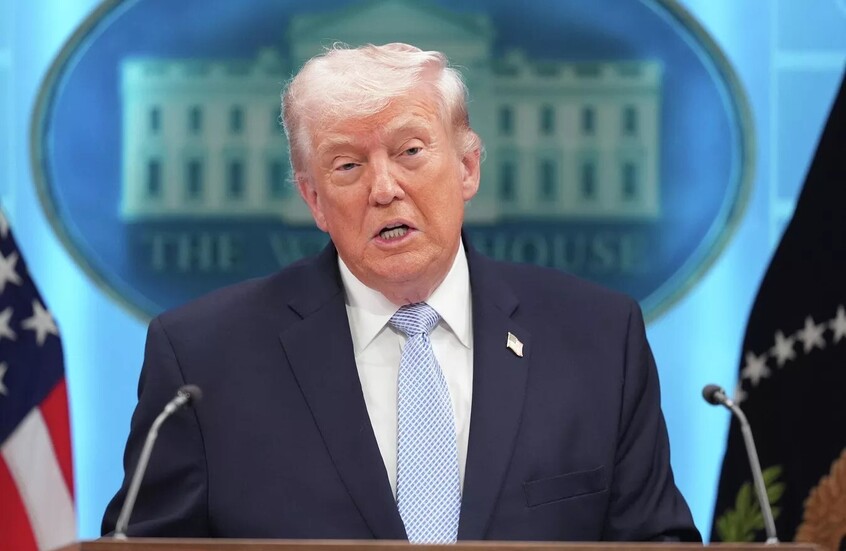
During a press briefing at the White House, Trump reiterated that the United States “will retrieve the nuclear dust one way or another,” stressing that Iran “will never have a nuclear weapon, and there will be no agreement without that.”
He added that Iran “has not agreed to refrain from obtaining a nuclear weapon,” emphasizing that his country will continue its policy of preventing Tehran from developing military nuclear capabilities.
In a related context, Trump said that “no country can blackmail the world by closing the Strait of Hormuz,” adding that the United States “does not use the strait and does not need it,” referring to its sufficient oil and gas resources.
He explained that there are “many tankers and ships heading to the United States to load oil,” noting that his country does not need other nations to participate in a blockade of Iranian ports, although he confirmed that “countries will join this maritime blockade.”
Trump also confirmed that “there is no fighting currently,” pointing out that what is taking place is a “blockade,” and that “the Iranians are not conducting any trade” under these measures.
He further revealed that his administration received “a call this morning from the right people regarding Iran,” without providing additional details, adding that “many U.S. presidents regret not taking earlier action on Iran.”
In conclusion, Trump stated that the United States may “turn to Cuba after finishing with Iran,” describing it as a “failed country.”
The maritime blockade announced by Trump on Iran came into effect on April 13, as U.S. naval forces began intercepting ships heading to or departing from Iranian ports, according to the U.S. Central Command (CENTCOM).
The blockade covers large areas of international waters surrounding Iran, focusing on the Strait of Hormuz, the Sea of Oman, and the Gulf, through which a significant portion of global energy supplies passes. CENTCOM stated that implementation began at 10:00 a.m. Eastern Time, based on a presidential announcement issued after talks between Washington and Tehran in Islamabad stalled.
Trump had earlier announced via the “Truth Social” platform the immediate start of the blockade, affirming that U.S. forces would intercept any vessels linked to Iranian ports, including those in international waters, and warning of a response to any targeting of military or civilian ships.
On the Iranian side, officials rejected the move, with Mohsen Rezaei stating that his country would not allow a blockade to be imposed and pointing to Iran’s unused military capabilities.
Economically, Bloomberg reported disruptions in global energy markets following the announcement, with Brent crude prices rising to nearly $104 per barrel, while gas prices in Europe also saw noticeable increases. This comes given the strategic importance of the Strait of Hormuz, through which about one-fifth of global oil supplies pass.
Internationally, UK Prime Minister Keir Starmer announced his country’s refusal to join the blockade, warning of its economic repercussions, particularly amid rising energy prices.
Source: RT