
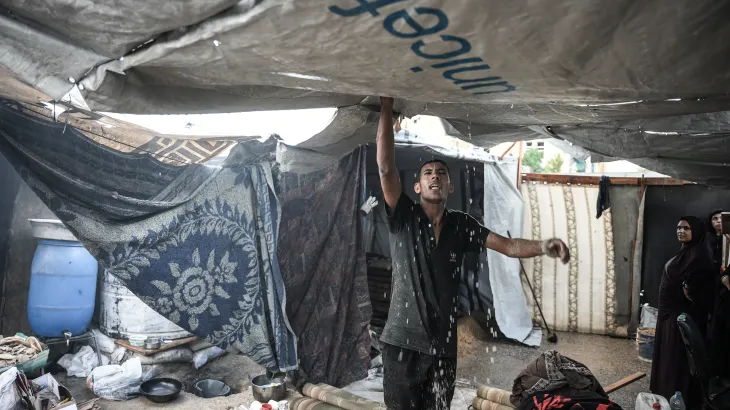
Tattered Tents in Gaza Claim the Lives of Unborn Babies and Threaten Mothers
Middle East News Network: Palestinian Mohammed Al-Dayeh never expected to lose his unborn child due to displacement conditions—not from Israeli gunfire or bombardment, but because of the tent he had been living in for nearly a year. The tent collapsed on him and his pregnant wife under the force of strong winds.
Al-Dayeh (36), a displaced man living in the “Qatari Ata Camp” on Salah al-Din Street at the entrance to Al-Bureij Camp in central Gaza, is waiting at Nasser Hospital in Khan Younis for news about his wife, Marleen Emad (30). She lies in intensive care in a coma, unaware that her seven-month-old fetus has died.
Recounting the incident, Al-Dayeh said that severe winds during the recent storm caused the tent to collapse, with one of its metal poles falling onto his pregnant wife’s abdomen, injuring her.
He added that he initially took her to Al-Awda Hospital in central Gaza, where he was told her condition was stable. However, her health rapidly deteriorated after returning to the tent. She lost consciousness and was transferred with great difficulty to Nasser Hospital in Khan Younis, where tests revealed that the fetus had died and that she was suffering from severe, life-threatening bleeding.
He continued that his wife remains in a coma in the intensive care unit in critical condition, while doctors are unable to perform a delivery operation until her condition stabilizes.
Al-Dayeh said that the loss of his unborn child was a direct result of life in the tents, expressing fear that he could also lose his wife at any moment due to her critical condition.
Al-Dayeh had been displaced seven times before settling in the Ata Camp, after his home in eastern Al-Bureij Camp was destroyed.
This case reflects the suffering of a wide segment of displaced people in the Gaza Strip, where approximately 1.5 million displaced individuals live in worn-out tents or temporary shelters. Reports indicate that around 125,000 out of 135,000 tents have collapsed, rendering most of them uninhabitable and exposing residents to increasing risks, especially during the winter season.
Source: WAFA